Friends, today we’re
excited to be kicking off a new occasional series about cat travel—not
traveling with cats, mind you, but
traveling to see cat-related attractions. And we’re even more excited to share
what we think must be the most interesting attraction in Gettysburg, Pennsylvania.
Just in case you’re not up on your Civil War history, Gettysburg was the site
of a major battle between North and South in July 1863. These days the town is
full of little shops and museums, and it is a fun place to visit.
Joining us today is Rebecca Brown, one of the owners and creators
of the Civil War Tails at the Homestead Diorama Museum in Gettysburg,
Pennsylvania. Rebecca, welcome to the blog. You and your twin sister, Ruth,
have a very unique museum. Can you briefly tell us what it’s all about?
Thank you for having me.
Civil War Tails is a museum of the dioramas that Ruth and I have been
making for over 20 years. We make all
the soldiers by hand, and most of the other features as well, from forts and
ships to horses and cannons and coffeepots.
The twist is that every soldier is actually a cat. Currently, we have over 5,500 cats on display
(out of over 8,000).
 |
This
diorama captures the moment in the Battle of Gettysburg
when the 20th
Maine began their forward movement
on Little Round Top.
Photo courtesy of Civil War Tails Diorama Museum. |
Since the figures are all to-scale and the dioramas each
show a specific point in time, they let us see what the scene might have looked
like in real-life. It’s like a glimpse
back in time. And, each diorama is
inspired by the stories of the men (and women) involved, so it’s a great way to
learn about the people of the Civil War and see how we can really relate to the
stories of these people from over 150 years ago.
Fascinating! Why did
you decide to use cats in your dioramas?
When we were 11 years old, I read biographies on Generals
Lee and Grant. Then I made the generals
out of clay—only I made them cats. It
was just natural to do it and now, looking back, I think it’s because we’ve
always had cats as pets, and we’ve always pretended we were cats, even if we
were playing Robin Hood (of course, the Sheriff of Nottingham and his bad guys
were always dogs). As we continued to
read about the Civil War, we continued making cats of officers who were gallant
or brave or just looked cute in their photos, and we would make cats for them
to command. Eventually, we began making
dioramas with them, to commemorate the various stories we read about. So, this really has just been our hobby since
1995.
So, aside from the
fact that the soldiers are cats, how historically accurate are the dioramas? Do
visitors get a feel for what really happened in the battles?
We try to make the dioramas as accurate as possible (besides
the tails). Each one is to-scale, so six
feet on the ground is six feet for the cat.
Each cat represents one soldier, which helps to give an idea of what the
overall scene would have looked like during the Civil War.
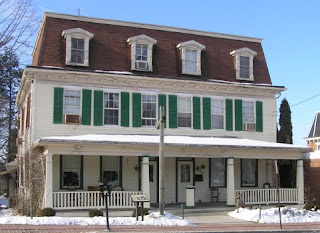 |
This is the Homestead. It used to be
part of an orphanage,
and now it’s home to the
Civil War Tails Diorama Museum.
Photo courtesy Civil War Tails Diorama Museum.
|
On the individual level, we add detail to all of our
figures. So, Confederate officers have
the Austrian knots on their sleeves, identified officers and men have correct
facial hair if a photo is available, the 72nd Pennsylvania cats have red piping
and buttons on their jackets (each one took Ruth 30 minutes to make, instead of
the usual 5–7 minutes), and so on. On
our Little Round Top diorama, each three-quarter-inch-tall Union cat will have
a tiny Maltese cross on top of his kepi (cap) as a corps badge.
On a diorama level, we try to
calculate the number of soldiers that would be present in the given units, we
check all our sources and maps to place identified officers and men as
accurately as possible, we take note of “minor” details like the fact that the
ironclad ship CSS Virginia (Merrimack) had her boats shot away on
the first day of fighting (i.e., they wouldn’t be present on our diorama of the
second day), and so on.
I do think our dioramas help people see history in
action. We’ve had visitors comment on
how helpful it was to see the Angle populated as it would have been during
Pickett’s Charge, after having gone to the battlefield itself. Or, if people come to the museum before
going, they can then picture the action later, as they stand on the actual
ground and look across the fields. Of
course, we have non-Gettysburg dioramas too, so people can see other scenes
like the ironclads CSS Virginia and USS Monitor duking it out.
I’m amazed at the
level of detail you add, down to the specific uniforms and even the facial
hair. What materials do you use in the dioramas, and roughly how long does it
take to create one?
The older cats are made out of modeling clay, which doesn’t
harden. Now, we use Sculpey, which is a
clay that we bake. The great thing about
Sculpey is that the cat can be glued down and he won’t melt, fall over, drop a
rifle barrel or arm, etc. This is also
true of our horses (over 80% of all our horses are handmade) and cannons.
 |
The
Browns include a remarkable level of detail,
right down to facial hair on
identifiable individuals.
This is Captain Spear on Little Round Top.
Photo courtesy Civil War Tails Diorama Museum. |
For ground cover, buildings, ships, trains, and other
features, we’ve traditionally used ordinary materials you can find around your
house, like toothpicks, paper clips, cardboard, and wire. We also use materials you can find at any
craft store, like reindeer moss for treetops or “turf” for grass. On our larger dioramas, we tell how to make
various aspects of the dioramas, like fences and trees, so kids can see how
easy it really is. The Angle looks
complicated, but anyone can do it. And
that’s why we have some of our older scenes pulled out, so kids (and adults)
can see how we started out—with blue and green paper for water and grass—and
know that making a diorama isn’t all that scary or daunting.
How long it takes to make a diorama depends on the size of
the diorama and the number of cats. The
Angle has probably taken about 4½ years, and we’re actually in the process of
tweaking it. When we’re finished, it
will have 3,000 cats on it. Little Round
Top has been in the works for four years, but we’ve probably only put about a
year and a half of work into it so far (it has been “overcome by events”). It’ll probably take two or three more focused
years of work to finish it. On the other
hand, the ironclads took about a year and a half to complete, since most of the
work was making the ships, with only a couple hundred cats on them, instead of
thousands. Smaller scenes might take a
few months.
I’m guessing you
haven’t always run a diorama museum. How did you end up there?
We were homeschooled, and in high school we did lessons on
the Civil War for other homeschooled students.
The kids really loved seeing our dioramas, particularly The Angle. We also began working at a retirement
community, so each year we would take our dioramas over for a one-day display
in their auditorium. The residents also
loved our dioramas. One lady would tell
us, every year, “You should take them into schools!” In 2012, I decided I really should take her
seriously and start thinking about it.
Well, by then we had not only The Angle (5.5’x7.5’), but Fort Sumter
(~4’x4’ and really heavy!) and Little Round Top (11’x4’8”), among others. Fitting them into a classroom did not seem
feasible! And, traveling is hard on the
older modeling-clay cats. So we began
considering starting a museum.
In spring of 2013, we bought the old Homestead in
Gettysburg. The house was built in 1869
as a girls’ dormitory for the National Soldiers’ Orphans’ Homestead next
door. Not only is it awesome to have our
museum up and running (we opened in the fall of 2015), but it’s mind-boggling
to be in a building with a history related to the battle (for the connection,
look up Sgt. Amos Humiston or “The Children of the Battlefield”).
Are there any real,
live cats at the museum?
Yes! Kitty is 17
years old and has fully embraced the title of “Museum Cat.” She enjoys saying “hi” to visitors and has
been known to come downstairs specifically to greet people. So, if you stop by, don’t forget to say hi to
her—assuming she’s on duty. Sometimes
the pillow upstairs is just too cozy and warm, so she takes a day off from
museum duty.
 |
Here is Kitty, the 17-year-old real cat you
might be lucky enough to meet when you visit
the museum.
Photo courtesy Civil War Tails Diorama Museum. |
Can you give us an
inside tip on Civil War Tails?
If you come to Civil War Tails, there are a few fun things
about the dioramas that I like to point out.
The ironclads have a couple surprises that I won’t spoil for you, there
is a tunnel on another diorama, and there is one dog somewhere… He’s a real dog, not a soldier, but it takes
a while to find him. If you want to
search for him, you might want to tell me, because I have a habit of showing
him to people, and that would spoil your scavenger hunt!
Do you have any
special events or additions planned for this year?
Last year we had fun with our first anniversary, and we are
looking forward to celebrating again this fall.
On Labor Day weekend (Friday, Saturday, and Monday), we will be offering
discounted admission and having a scavenger hunt with prizes. If you’re interested, just keep an eye out on
our Facebook page or website (
www.civilwartails.com)
as Labor Day approaches.
As far as additions go, we do have several older dioramas in
storage that we would like to bring out.
We just brought out a couple for display—Capt. Bigelow’s 9th
Massachusetts Battery at Gettysburg, and Gen. Joe Wheeler’s Confederate cavalry
leaping off a 25-ft cliff into the Duck River.
The cats and horses are all cleaned up, repainted, and happy to be out
of the closet!
This has been really fascinating, Rebecca. We're so glad you could join us today and tell us about the diorama museum. It sounds like an excellent place to visit! Friends, if you want to learn more about the Civil War Tails Diorama Museum, check out the details below.
Information
The Civil War Tails Diorama Museum is located at 785 Baltimore Street, Gettysburg, PA 17325.
You can reach them by email at
info@civilwartails.com or by phone (717-420-5273). Also check out their website (
www.civilwartails.com) and keep up with them on Facebook (
www.facebook.com/civilwartails).
Civil War Tails is a family-run museum, so hours can vary a little, but they are open most evenings until 8:00. Be sure to email them or check their
hours page before visiting.


