A note about The Cuddlywumps Chronicles

This blog is written and maintained by Miss Cuddlywumps, a fluffy-tailed calico cat who is both classically educated and familiar with mysteries. She receives creative input from the Real Cats and clerical assistance from She of Little Talent (old SoLT, a.k.a. Roby Sweet). Comments or complaints should be addressed to Miss C rather than to old SoLt (Ms. Sweet). Ms. Sweet accepts no responsibility for Miss C's opinions.
Showing posts with label Mythology. Show all posts

Thursday, July 13, 2017

Norwegian Forest Cat: The Official Cat of Norway

Norwegian Forest Cat: Made in Norway!The Norwegian Forest Cat is a cat after my own heart because it has been around for a long time and has appeared in the mythology of its country of origin. Obviously I am speaking of Norway, and the mythology is Norse. But I am getting ahead of myself. Let’s meet the cat first.

A sturdy, affectionate, and gregarious breed


Norwegian Forest Cats are known for being affectionate, gregarious, and intelligent. They will even greet their people at the door. “Wegies,” as they are called in some circles,[1] adapt to change more easily than many other cats.

Norwegian Forest Cats, or Wegies, are well
adapted to cold weather.
Photo by Pieter Lanser [CC-BY-2.0],
via Wikimedia Commons.
They are sturdy cats, and generally healthy. With their insulated double coat that has water-resistant guard hairs over a warm undercoat, Wegies can be happy going for a stroll in the snow. Their tufted paws are also helpful in snow. They have a ruff, a bushy tail, and ears that  are heavily furnished (which means they have hair growing from inside their ears—an undesirable trait in humans, but a desirable one in some cats!). Wegies’ almond-shaped eyes can be gold to emerald green in color. Their coat can be nearly any color, but so far as we know, there are no chocolate, lilac, or pointed Wegies.

Norwegian Forest Cats are slow to mature, only reaching full size at about 5 years old. For females, “full size” is typically 9–12 pounds; for males, 12–16 pounds. They don’t need as much grooming as you might expect (a once-a-week brushing is usually enough), though they do shed their winter coat in the spring, so more grooming is needed at that time (the Cat Fanciers’ Association describes this as the “annual molt”). Wegies like to be with people and are good with children. In the wild, they spend a lot of time up in trees, so they would like to have something nice and tall to climb on at home.


And now, the history and mythology

The Norse goddess Freya in her chariot pulled by two
blue cats. They don't look much like Skogkatt here,
but that is what they are believed to represent.
© Patrimonio | Dreamstime.com - FreyaNorse Goddess Photo
In Norway, where it is a naturally occurring breed, the Wegie is called Skogkatt (“forest cat”). They have been around a long time and apparently arose from shorthaired cats brought into parts of northern Europe by the Romans. The thick coat, furry paws, and other features typical of Skogkatt developed over a period of some years as the cats adapted to their environment.


Norse mythology has several references to large cats that we think must by Skogkatt. For example, the Prose Edda (ca. 1179–1241) mentions that the goddess Freya has two large cats that pull her chariot (these cats happen to be blue; see our post “The Goddess Freya’s Cats” for more). Another story features a cat so huge, even the great god Thor could not lift it. Cats were important in Norse culture and were often given to young women as wedding gifts, presumably because of their association with Freya, the fertility goddess.

The Norse goddess Freya in her chariot pulled by two blue cats named Bygul and Trjegul. © Patrimonio | Dreamstime.com - FreyaNorse Goddess Photo
Norwegian Forest Cats love to climb!
If you get one, you must provide
climbing opportunities.
Photo via Adobe Stock.
The Danish clergyman Peter Clausson Friis (1545–1614) lived in Norway and described three types of lynx: a wolf lynx, a fox lynx, and a cat lynx. His “cat lynx” is thought to be the Skogkatt.  Somewhat later, in the 19th century, the cats appeared in fairy tales penned by Peter Christen Asbjørnsen and Jørgen Moe. These authors wrote of “fairy cats” or “huldrekatt.” Huldrekatt lived in the forest and had long, bushy tails, so we suppose they must have been Skogkatt.

The modern history of the Norwegian Forest Cat

In 1938, a Wegie made the breed’s first appearance at a cat show, in Oslo. World War II interrupted the breed’s development though, and it was the 1970s before a standard was described and a breeding program began. In 1973, two purebred Wegies, named Pippa Skogpuss and Pans Truls, were bred and had two kittens. Pans Truls would later be recognized as THE Skogkatt—the standard by which all others would be judged.

The first Norwegian Forest Cats to officially reach the United States arrived in 1979 (although they may have reached North American shores much earlier, in the late 10th century with the explorer Leif Erikson [d. 1020]). They reached the United Kingdom a few years later, in 1986.

Today, these beautiful, people-oriented cats are beloved by their humans as they take a little Viking flair everywhere they go.

Learn more!

We've written about the Skogkatt before, in the posts "What Kind of Cat Would Santa Claus Have: Part 1" and "Did Vikings Have Cats?"

Sources

"About the Norwegian Forest Cat." The Cat Fanciers' Association website. http://cfa.org/Breeds/BreedsKthruR/NorwegianForestCat.aspx.

Pickeral, Tamsin. "Norwegian Forest Cat." The Elegance of the Cat: An Illustrated History. Hauppauge, NY: Barron's, 2013.

(Top illustration created with Adobe Stock images.)


[1] The Norwegian Forest Cat is also called an NFC, but “wegie” sounds more like a friendly name and less like a government agency, so we will go with that.

Thursday, March 16, 2017

Cats in Space: Constellations

Recently under the topic “Cats in Space,” we posted about nebulas named after cats (or, rather parts of cats). Today we’re tackling feline constellations. The first of these, Leo, you’ve certainly heard of, especially if you were born between July 22 and August 22. The other three you might only be aware of if you are really into stars.

The constellation Leo in the night sky
The constellation Leo. Note the "backwards question mark" formation
on the right.
Illustration by ad_hominem, via Adobe Stock.

Leo

Herakles and the Nemean Lion, Greek postage stamp
Herakles struggles with the Nemean Lion on this
Greek postage stamp.
Photo by Lefteris Papaulakis, via Adobe Stock.
Leo, the Lion, is one of the largest constellations, and also one of the most ancient. It was cataloged by the Egyptian astronomer Ptolemy (c. AD 100–170) in the second century, but its origins stretch back much farther than that. The Mesopotamians may have had a lion constellation way back in 4,000 BC. Other ancient peoples also had a lion constellation—notably the Persians, who called it Shir or Ser, and the Babylonians, who called it UR.GU.LA (“The Lion,” in case your Babylonian is rusty, and if you want to brush up even more, check out these posts on how to say "cat" in Old Babylonian and Neo-Babylonian). To the Babylonians, the Lion marked the summer solstice.
   

This constellation is commonly associated with two mythological beasts: the Nemean Lion and, somewhat less commonly, the Sphinx. The Nemean Lion was a fearsome lion that terrorized the Valley of Nemea in Greece. Its hide could not be penetrated by ordinary weapons, so ordinary men could not kill it. Heracles (whom you may know as Hercules) killed this lion as the first of his famous twelve labors. Thereafter, he wore its hide as a symbol. The Sphinx, of course, was a beast with a lion’s body and a human head. We associate the sphinx mostly with Egypt, but the creature was also known in Greek myth.

Leo is a constellation of the northern hemisphere. Its most prominent feature is the “backwards question mark” formed by the stars that outline the lion’s head. Its brightest star is Regulus, which is actually a four-star system.

You can learn a lot more about Leo, including how to find it in the sky, from this video:


Leo Minor

Sphinx sculpture in Metropolitan Museum of Art, New York
A sphinx in the Metropolitan Museum of Art, New York. The sphinx
is also sometimes associated with the constellation Leo.
 Photo by Юкатан [Public domain], via Wikimedia Commons
Leo Minor, or the Smaller Lion, lies sort of in between Leo and another feline constellation, the Lynx. Unlike its larger cousin, Leo Minor is a younger constellation, created by Polish astronomer Johannes Hevelius in 1687. It was briefly renamed "the Lionness" in 1870, but this name never really caught on.

The brightest star in Leo Minor is Praecipua. Interestingly, Leo Minor includes three stars that are known to have exoplanets: HD 87883, HD 82886, and Kelt-3.

Lynx

The Lynx was also created by Johannes Hevelius (1611–1687), who wanted a little something to fill a gap between two other constellations. He called the star formation the Lynx because he said it was so faint, you’d need a lynx’s eyesight to find it. Lynxes were thought to have extraordinary, even magical eyesight. Greek folklore held that they could see through walls, and medieval Christians considered the lynx a symbol of Christ’s omniscience because of its keen sight. Though the Lynx constellation isn’t commonly associated with any myths, to some viewers it brings to mind an Argonaut (yes, as in “Jason and the Argonauts”) named Lynceus, whose eyesight was so good he could see through walls and even underground.

The constellation Lynx as depicted in an 1825 etching by Sidney Hall.
Though the Lynx is faint and difficult to find in the sky, it is near Leo Minor and Ursa Major.
Via Library of Congress, Prints and Photographs Division.

Felis

Some constellations endure, and some don’t. Felis (the Cat) didn’t. It was created in the 18th century by Joseph Jerome Le Francais de Lalande (1732–1807). He liked cats, so he created a cat constellation for star charts of the time. You won’t find Felis on modern star charts though.

The other three feline constellations can still be found, so next time you gaze up at the night sky, be sure to look for the cats!

Sources


Mercatante, Anthony S., and James R. Dow. The Facts on File Encyclopedia of World Mythology and Legend, 2nd edition. New York: Facts on File: 2004.

Rao, Joe. “Find the Felines: Cats in the Night Sky.” Space.com. http://www.space.com/963-find-felines-cats-night-sky.html

Friday, July 15, 2016

10 Cat Names from Greek Myth: Gods and Goddesses


Because naming a cat is no easy thing (at least it shouldn’t be—and yes, I’m talking to all you people who name your cats "Kitty"), we are pleased to bring you the first in a series of cat names from Greek myth. Today’s post covers gods and goddesses. Many are obvious, but we hope there are one or two here that you haven’t thought of. Enjoy!


Gods

Hello, Hades?
1. Zeus: Head god in charge (sort of, and if you know anything about Greek myth, you know what I mean). Good name for the cat who is lord over all he surveys, except when he isn’t. Also for the cat who flings thunderbolts.
   
2. Hades: Lord of the Underworld. Maybe for a barn cat who’s a champion mouser. Or for any cat with an underworldy air about him.

3. Apollo: Associated with music, prophecy, and the sun. A name for the cat whose looks and stature just say “Greek god.” Especially appropriate if his hobbies are singing and napping in sun puddles.

Got a cat who hangs with horses?
Name him Poseidon. Most
people will be mystified.
4. Poseidon: God of the sea. Also associated with earthquakes and horses. For that rare cat who loves water and horses, or for the active cat who creates mini-earthquakes in your home.


Goddesses

5. Hera: Zeus’s main gal. For the cat with a jealous streak. Or for a cat who loves peacock feathers.

6. Demeter: Goddess associated with crops and fertility. For the cat who can’t get enough cat grass. Also, you could call her Demi for short.

7. Artemis: The hunter. For the cat who periodically gifts you with a little dead thing, or for the cat who’s great at “killing” catnip toys.

Clearly, this kitty loves crafts.
Athena.
8. Athena: Goddess of warfare (especially defensive) and craftsmanship. For the cat who defends her spot atop the cat tree against all threats, foreign and domestic. Also for the cat who’s always creating messes out of your craft supplies.

9. Persephone: Queen of the Underworld. She’s also the daughter of Demeter. For an underworldy sort of cat who likes to slink among the shadows.

10. Hestia: Goddess of the hearth. For the cat whose hobby is sleeping in front of the fire. She’s the kind of cat who becomes the soul of your home.
The cat who lounges by the fire and is the soul
of your home.
Hestia.


Bonus content! Names for pairs of cats

Zeus/Hera: For your favorite male/female pair.
Hades/Persephone: For the male/female pair who’s got that underworldy thing going on.
Demeter/Persephone: For the mother/daughter pair.
Apollo/Artemis: For the brother/sister pair.


Photo credit: All images from Adobe Stock.

Friday, November 7, 2014

The Goddess Freya’s Cats

Our subject today is Norse mythology, and specifically the goddess Freya and her cats. And we are not talking about little lap kitties here. No, these cats were powerful creatures who pulled the goddess’s chariot.


Freya in chariot pulled by two blue cats

The Norse goddess Freya in her chariot pulled by two blue cats
named Bygul and Trjegul.
© Patrimonio | Dreamstime.com - FreyaNorse Goddess Photo

The goddess Freya and her cats


Freya (or Freyja) was a fertility goddess and was associated with domesticity, womanhood, and female sexuality. She was also associated with sorcery and magic, as well as war and death. It was said that after a battle, Freya would lead a band of Valkyries to gather the fallen warriors—or half of them, at least. She would take her share of the dead to Folkvang, her hall in the home of the gods, while the other half went to Odin, god of wisdom and war. Freya might also have been the goddess on hand to greet women after death.

Freya’s chariot was pulled not by horses but by two male cats. Both cats were described as being blue or gray and had been a gift from Thor. Their names (bestowed upon them not by the ancient Norse but by a modern author, according to the Viking Answer Lady) were Bygul and Trjegul.

Why cats? Well, cats have been associated with femininity and fertility since ancient Egypt, so it isn’t surprising that cats would be associated with Freya in Norse mythology. But if Freya was the goddess of the feminine, why were her cats male? It may be that the association of Freya and these male cats represented a combination of female and male sexuality (Prehal, p. 16).

Thor gives Freya two blue kittens

1981 Sweden stamp showing Freya in chariot pulled by cats
1981 Sweden stamp shows Freya in her chariot
pulled by three…cats?
Stock image via AdobeStock.
According to a Russian tale based on Norse stories, Freya’s cats were a gift from Thor.

One day while Thor was fishing, he heard a beautiful singing that lulled him to sleep. Soon enough, though, he was awakened by a horrible noise. Irritated, he went in search of the noise and came upon the magic Cat Bayun and two blue kittens. The kittens were asleep, and the cat, a male, was singing to them.

Thor asked if Cat Bayun was the kittens’ father, and the cat replied that he was. He’d met a pretty female in the spring and together they’d had these kittens, but now their mother had left him and he was stuck as a single father. He asked for Thor’s help, and Thor got the idea to give the kittens to Freya.

Bayun then turned into a bird and flew away, and Thor gathered up the kittens and took them to Freya. Those kittens grew into the cats that pulled Freya’s chariot.

Sources

Prehal, Brenda. Freyja’s Cats: Perspectives on Recent Viking Age Finds in Þegjandadalur North Iceland. Master’s thesis. Hunter College of the City University of New York. 2011.

The Encyclopedia of Ancient Myth and Culture. London: Quantum Books, 2003.

The Facts on File Encyclopedia of World Mythology and Legend. 2nd ed. Vol. I. New York: Facts on File, 2004.

Friday, September 19, 2014

The Egyptian God Who Became a Cat to Kill a Snake-Demon


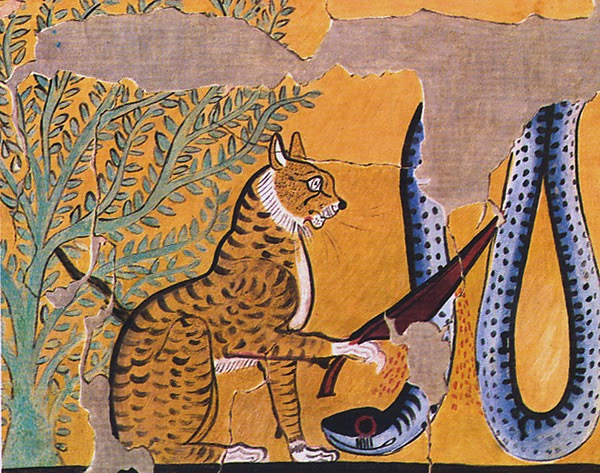
Miss Cuddlywumps introduces the Egyptian sun god Ra, who, as a cat, killed a snake-demon every night


In ancient Egypt, cats were valued for their ability to kill creatures that were potentially dangerous to humans. I am referring here to rodents, scorpions, and snakes. And when an Egyptian god took on the form of a cat, he could kill a demon creature far more dangerous than the flesh-and-blood serpent it resembled. This cat was required to kill a snake that could stop the sun from rising.


Facsimile painting by Charles K. Wilkinson
of scene in Ramesside tomb at Deir el-Medina
(c. 1295–1213 BC).
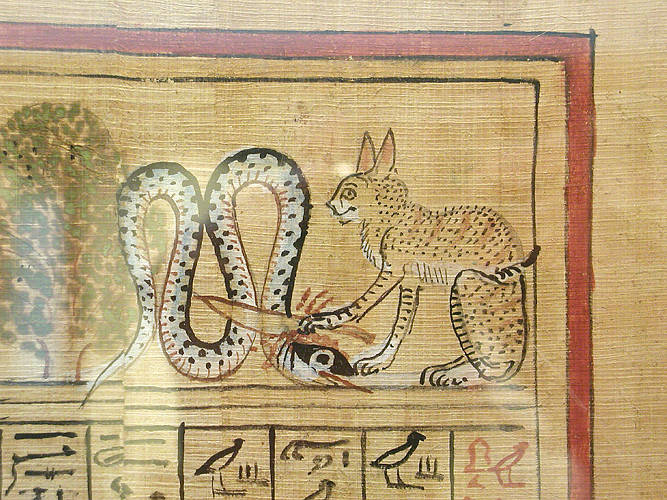
The sun god Ra was the creator of all life and the strongest of the Egyptian gods. As the story goes, Ra journeyed across the sky each day, and each evening, as Atum-Ra, he slipped beneath the horizon and entered the underworld. There, in the guise of the “Great Tomcat” or Mau, Atum-Ra confronted the evil snake-demon Apophis, who was darkness and chaos. The god had to kill his enemy so he himself could return to the world in the morning as the shining sun.


 Jon Bodsworth (photographer).
[Public domain], via Wikimedia Commons.
The confrontation between Atum-Ra and Apophis is seen in Egyptian tomb paintings and in the Book of the Dead. Most depictions show the god as a cat, using a knife to cut off the serpent’s head. Sometimes the cat is shown simultaneously crushing Apophis’ head with one paw while decapitating him with a knife held in the other paw.

As Jaromir Malek wrote, “These are no pussycats but strong and powerful animals” (p. 84). He speculated that these cats were based not on domestic cats but on wild servals.


wall painting in tomb of Inherkha, Thebes (c. 1160 BC).
Uploaded by Eisnel at en.wikipedia.
Licensed under Public domain via Wikimedia Commons.


The feline creature depicted in the Theban tomb of Inherkha (c. 1160 BC) is especially wild- and fierce-looking. It has a large, muscular body, long ears, and a long tongue. No housecat ever looked quite like that! It could be, as Malek said, that this is an imaginary catlike creature, designed by the artist to be more fearsome and powerful than any existing cat.

Sources


Engels, Donald. Classical Cats. London: Routledge, 1999. 

Malek, Jaromir. The Cat in Ancient Egypt. Revised ed. London: British Museum Press, 2006.