A note about The Cuddlywumps Chronicles

This blog is written and maintained by Miss Cuddlywumps, a fluffy-tailed calico cat who is both classically educated and familiar with mysteries. She receives creative input from the Real Cats and clerical assistance from She of Little Talent (old SoLT, a.k.a. Roby Sweet). Comments or complaints should be addressed to Miss C rather than to old SoLt (Ms. Sweet). Ms. Sweet accepts no responsibility for Miss C's opinions.
Showing posts with label Ships' Cats. Show all posts

Monday, June 4, 2018

Book Review: Seafurrers

Seafurrers: The Ships' Cats Who Lapped and Mapped the World, by Philippa Sandall
Today we are pleased to bring you our short review of the fascinating book Seafurrers: The Ships’ Cats Who Lapped and Mapped the World, by Philippa Sandall and illustrated by Ad Long. This book covers the history of cats on ships from the very beginning, when cats took up duty stations on grain ships to feast on the rodents that ruined the cargo; to the years of exploration, when cats went along on the search for a route to the Pacific and on explorations of Antarctica; to stories of cats on warships; and finally to the end of cats and other live animal pets or mascots on Royal Navy ships in the 1970s.

First, let us tell you that this is not a boring old history book full of stuffy, dense prose. It is instead a thoroughly engaging read divided into short chapters called “incidents,” which include asides from a cat (“According to Bart”) and call-out boxes with additional interesting facts. Plus there are lots of photos of sailors and their cats and photo illustrations of cats on ships (our favorite of which is the cat coming up the gangplank wearing a sailor’s hat and with a pile of crates behind him marked “Cat”).

Second, let us tell you that, yes, Seafurrers is about cats, but it’s not just about cats. We learned about lots of other things too. Like how much grain a single rat or mouse can spoil, some particulars of voyages of discovery we didn’t know before…oh, and some stuff about squid. And of course we learned a lot about seafaring cats—for example, about cats catching flying fish, cats falling overboard and being rescued, the cat that survived the sinking of the USS Maine, and the cat who shared tent space with a pair of penguins.

We think if you have even a passing interest in ships’ cats and/or seafaring in general, you will love this book. It is well written, well designed, and a joy to read. When we got to the end, we wished it could have gone on a little longer. Thankfully, Bart also has an excellent blog that is worth a read.

The book and blog are both highly recommended!

Two Paws Up! A Great Read

A note on the "Paws Up" system: Miss C gives either one or two paws up. One paw is for a good read; two paws is for a great read. She never gives three or four paws because that would require her to lie on her back...and Miss C does not do that!

The link below is an Amazon Associates link. If you make a purchase through this link, old SoLT and I could get some coin for our kibble account. Thank you!


Thursday, May 10, 2018

Jimmy the Cat: Mascot of the HMS Renown


Cats in History


Some cats get around more than others, and Jimmy the cat, a fluffy, light-colored fellow who lived during World War I, had experiences on land and sea that most of us can’t imagine.

Jimmy “transfers” from land to sea

Jimmy the cat. Georgina Shaw Baker.
This pastel drawing of Jimmy was done by Georgina Shaw Baker.
National Maritime Museum, Greenwhich, London. [CC BY-NC-SA].

We’re not sure where he started life, but Jimmy and his person, an Australian whose name is unknown, spent time together in the war’s trenches until the person was wounded and sent to London. Jimmy went along with him, and while the two were at Victoria Station, a fortuitous meeting took place. Jimmy’s person happened to meet a Royal Navy cook named F. Conway, who was interested in the cat. Knowing he wouldn’t be able to keep the cat with him (we’re not totally sure why, but we suspect something like a “no cats in the hospital” rule was to blame), the Australian turned Jimmy over to Conway.

Wounded in the Battle of Jutland

At that time, Conway was assigned to the HMS King George V, and he took Jimmy aboard with him. The King George V was a dreadnought battleship that was part of the Royal Navy’s Grand Fleet and spent most of the war patrolling the North Sea. On May 31, 1916, the ship took part in the Battle of Jutland, in which the Royal Navy attempted to destroy Germany’s High Seas Fleet.

Unfortunately, Jimmy was on deck during the fight, and his left ear was hit by shrapnel when a shell exploded near him. We don’t know any cats who would stay outside in the noise of a naval battle, but that’s what Jimmy did. Afterward, he needed a few weeks for his ear to heal, but then he went right back up on deck.

Clearly, Jimmy was born to be a Royal Navy cat.

Transfer to HMS Renown

When Conway was sent to be a cook on the newly launched battlecruiser HMS Renown, Jimmy went along. We know a little more about his life on that ship, which also patrolled the North Sea but was not in any battles. Jimmy became the ship’s mascot, beloved by the crew. He was a social cat and liked to hang around with the crew, especially when there was any sort of sport going on.

HMS Renown ca. 1918
HMS Renown (1916), photographed ca. 1918.
Official US Navy photograph. Public domain.

The cat still spent much of his time with Conway, though, and could often be found in the galley, where he could sometimes score a bit of food. He also slept with Conway, waking him at six every morning.

  
Jimmy the Cat postcard by Dumb Friends League.
The Dumb Friends League created
this postcard of Jimmy.

Jimmy’s retirement

That ear injury still gave Jimmy trouble, though, and so when Conway left the Renown on leave in 1917, he took the cat along. Jimmy’s sea career was at an end, as Conway left him in Chelsea with the Dumb Friends League. The cat then got involved in fund-raising for the league and became quite well known. He also got regular visits from his former shipmates.

Jimmy died in 1924 and was reportedly mourned by many. Truly, his was a life well lived.

Sources

Bulanda, Susan. 2014. Soldiers in Fur and Feathers: The Animals That Served in World War—Allied Forces. Crawford, CO: Alpine Publications.

“HMS King George V (1911).” 2018 (last edited). Wikipedia. https://en.wikipedia.org/wiki/HMS_King_George_V_(1911)

“HMS Renown (1916).” 2018 (last edited). Wikipedia. https://en.wikipedia.org/wiki/HMS_Renown_(1916)


Thursday, July 6, 2017

Simon of the Amethyst and the Yangtze Incident

Cats in history badge


The events we describe in this post occurred in 1949 on China’s Yangtze River. China was in the midst of a civil war between the Nationalists, under Chiang Kai-Shek, and the Communists. At the time of the Yangtze Incident (also called the Amethyst Incident), the British Embassy was located in Nanking (Nanjing), on the lower Yangtze River. The embassy was protected by a Royal Navy ship. An attempt to relieve the ship on duty there would lead to an international incident that would make one cat famous.

Simon becomes a ship’s cat

The black-and-white cat the world would come to know as Simon was born in Hong Kong after World War II. The young tom was probably about a year old when he was found in Hong Kong’s dockyards in 1948 by Ordinary Seaman George Hickinbottom of HMS Amethyst. Hickinbottom snuck the cat onto the ship, where young Simon soon went to work hunting the pesky rodents that were aboard.

The cat became a favorite of the ship’s captain, even sleeping in the captain’s hat (when the captain wasn’t wearing it, of course). When a new captain, Lieutenant Commander Bernard Skinner, took over, Simon was allowed to stay.

HMS Amethyst during World War II. Public domain.
HMS Amethyst during World War II.
By Royal Navy official photographer [Public domain], via Wikimedia Commons.

Up the Yangtze, the Amethyst is attacked

In spring of 1949, Amethyst was ordered to sail up the Yangtze to relieve the HMS Consort at Nanking. It was just after 8:30 a.m. on April 20 and the frigate was about 60 miles from its destination when it was first fired upon from shore. The small-arms fire fell short, and Amethyst continued on, but an hour later she was shelled from another shore battery. This time the ship was hit and damaged. Lieutenant Commander Skinner was mortally wounded in a direct hit on the bridge, and all other bridge personnel were disabled. In all, twenty-two men were killed and 31 wounded. Arrangements were made to evacuate the wounded, leaving aboard about 60 unwounded men.

During the attack, Simon was so badly wounded by facial burns and shrapnel, the crew feared he would not survive. Nevertheless, he was tended to by the medical officer like any other crew member.

The Amethyst becomes a captive, and Simon resumes his duties

Able Seacat Simon, cover
Simon's story has inspired several books.
The Amethyst itself was also hurt—grounded on a sandbar, its steering mechanism damaged. Communist snipers continued to fire at anyone who moved on deck. The ship was successfully refloated on April 21, and three days after the attack, military attaché Commander John Kerans arrived to take command. The dead were buried at sea. Still the Amethyst was unable to move without being fired on. The ship sat there for months.

Simon was recovering, and he resumed his duties of catching rodents. The crew’s morale improved a bit after he caught his first rat. Unfortunately, the new captain didn’t like cats, and Simon had a hard time making friends with him. Kerans wasn’t quite won over when Simon presented him with a dead rat, but when the cat tended to the commander as he recovered from an illness, the ice between them thawed.

The cat caught at least a rat per day, helping to protect the precious food stores and keeping the rodents out of the crew’s living quarters. He also visited with crewmen who’d been traumatized by the ordeal they were living through. He even killed the enormous, aggressive rat the crew had named Mao Tse-tung. That action earned him a promotion to the rank of “Able Seacat.”

Escape!

By the end of July, with their supplies running low, Commander Kerans knew that they would have to try to escape. So, on the night July 30, Amethyst raised its anchor and started downstream, following in the wake of a passenger steamer that happened by at just the right moment. The steamer provided a distraction, so when the shore battery opened fire, the gunners aimed not for the Amethyst but for the steamer, which was sunk.

The Amethyst, meanwhile, proceeded downriver, escaping to free waters. On August 1, the crew, Simon included, were awarded the Amethyst campaign ribbon. After undergoing repairs, the ship returned to Britain in October and was greeted jubilantly, as seen in this clip from British Pathé (Simon is seen briefly at the 2:17 point):


A gallant cat meets his end

Simon’s story had become quite well known, and word was out that he was to receive the Dickin Medal, awarded by the UK to animals for gallantry. Unfortunately, the cat was put into quarantine upon his return to Britain and while there, he became ill with a virus. Although Simon was young and received treatment for his illness, he had a weak heart, which made it harder for him to recover. He died on November 28, 1949. His Dickin Medal was awarded posthumously. He is the only cat ever to be awarded this medal.

Simon was buried with honors in the PDSA animal cemetery in Ilford. Today, a stone monument marks his resting place.

Burial place of Simon, cat of the Amethyst, in PDSA animal cemetery, Ilford
The monument marking Simon's resting place in
Ilford Animal Cemetery.
Photo by Acabashi (Own work) [CC BY-SA 3.0], via Wikimedia Commons.

The Dickin Medal, awarded to animals for gallantry in war
The Dickin Medal, awarded by the UK
to animals for gallantry in war.
Simon is the only cat to
have received the medal.
Unfortunately, his was awarded
posthumously.
Photo by Andrew69. (own work)
[Public domain], via Wikimedia Commons. 

Sources

“Amethyst Incident,” Wikipedia, https://en.wikipedia.org/wiki/Amethyst_Incident.

“Simon of the Amethyst,” chapter 8 in Silent Heroes: the Bravery & Devotion of Animals in War, by Evelyn Le Chêne (London: Souvenir Press, 2009 [paperback ed.]).


 “Simon, of HMS Amethyst,” Purr ’n’ Fur, http://www.purr-n-fur.org.uk/famous/simon.html. (Includes the most detailed version of Simon’s story we’ve found online, as well as several photographs of Simon.)


Thursday, March 23, 2017

Mrs. Chippy: Cat of the Endurance Expedition

Photo of Mrs. Chippy on Perce Blackborow's shoulder
The male tabby named Mrs. Chippy perches on Perce Blackborow's
shoulder aboard the Endurance, 1914.
By Frank Hurley [Public domain], via Wikimedia Commons
Years ago, people went off in sailing ships to explore far-flung parts of the globe, and they took cats with them. For one thing, cats were good company, capable of providing light entertainment, and for another thing, cats were rather good at killing the mice and rats that inevitably hitched a ride on the ships. One of the most famous of these cats was Mrs. Chippy, a tabby cat from Glasgow, Scotland, who wasn’t a “Mrs.” at all and who sailed to Antarctica with Ernest Shackleton, never to return.

Mrs. Chippy joins the expedition

In 1914, Ernest Shackleton was putting together something called the Imperial Trans-Antarctic Expedition (also known as the Endurance Expedition). Shackleton intended to make the first land crossing of the Antarctic continent. For this, he needed crews for two ships, and a Scotsman named Harry McNish (also spelled “McNeish”) joined up as the carpenter for the Endurance. As the story goes, McNish found his tabby cat curled up in his toolbox, and he took this as sign that the cat wanted to come with him. So, when McNish boarded the ship in London, along came the tabby.

“Chippy” is a British nickname for a carpenter, and the tabby quickly came to be called Mrs. Chippy for her habit of sticking close to McNish. The cat had been on board for a month before the crew discovered that Mrs. Chippy was actually Mr. Chippy, but still the original name stuck.

Heading south, Mrs. Chippy makes a new friend

Photo of Endurance in full sail, c. 1915
The Endurance in full sail, c. 1915.
By Frank Hurley [Public domain],
via Wikimedia Commons.
The Endurance sailed on August 8, 1914, for Buenos Aires. It was during the stop there that young Perce Blackborow, still just a teen, stowed away on the ship. Blackborow was allowed to stay after he was discovered, and he became a friend of Mrs. Chippy. The only known photo of the cat shows him perched on Blackborow’s shoulder.

Mrs. Chippy was well liked by the crew. He was friendly, a good mouser, and known for his ability to balance on the ship’s rails even in rough seas. He was less popular among the sled dogs, as he liked to tease them by walking atop the kennels they were kept in.

Map of proposed Endurance expedition route
Map showing the planned route
of the expedition.
March 25, 1916.
Public Domain, via Wikimedia Commons.
From Buenos Aires, the expedition sailed on to South Georgia and then to Antarctica. The plan for the Endurance was to land a party in a bay off the Weddell Sea. From there, the explorers would trek across the continent to the Ross Sea, by way of the South Pole. Meanwhile, a second ship, the Aurora, was to sail on to the Ross Sea. But things did not go to plan.

Trapped

The Endurance encountered ice along the way to the intended landing site, which presented more difficulties than Shackleton had anticipated, and the ship eventually became trapped in pack ice in 1915.  At first, Shackleton had the men try to free the ship with chisels and saws, but it was no use, and they all realized they’d be spending the winter on the ice. They tried to get word out with their wireless, but they were too far away from civilization for it to work. The sled dogs were taken off the ship and housed in “dogloos” (kennels made of ice). Mrs. Chippy mostly preferred to stay aboard the ship.
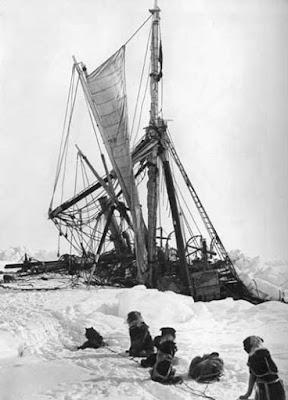
Endurance, crushed by ice and sinking, November 1915
The Eundurance, crushed and sinking,
November 1915. A few of the sled dogs
are seen in the foreground.
By Royal Grographic Society [Public domain],
via Wikimedia Commons
Things went tolerably well until October, when the ice truly began to crush the ship. Endurance had to be abandoned on October 27, 1915. The men and animals who’d been aboard her were well and truly stuck. A new plan was needed, but unfortunately for Mrs. Chippy, it did not include a cat.

The end for Mrs. Chippy

Shackleton determined that their best chance of surviving lay in marching across the ice to the west to reach the nearest land, some 350 miles away. He determined that only the strong would survive this journey, and he ordered the crew to shoot the weakest animals, including Mrs. Chippy. This was carried out on October 29. Shackleton wrote, “This afternoon Sallie’s three youngest pups, Sue’s Sirius, and Mrs. Chippy, the carpenter’s cat, have to be shot. We could not undertake the maintenance of weaklings under the new conditions.” Those who were closest to the animals killed, including McNish, “seemed to feel the loss of their friends rather badly.”

A long journey toward rescue

Harry McNish, ship's carpenter for the Endurance
Harry McNish, 1914.
Portrait cropped from photo in
South with Endurance.
Public domain,
via Wikimedia Commons.
The march was short-lived, as it proved too difficult to negotiate the uneven ice. The crew instead made camp not far from the ship and waited for the ice to break up. They were able to retrieve more supplies from the Endurance until the ship finally sank on November 21. By April 1916, they had drifted to within sight of land, and with their ice pack breaking up, Shackleton decided it was time to try a lifeboat journey. In three lifeboats, the crew made a perilous, icy trip to Elephant Island.

It was good that they had reached land, but the land they reached was uninhabited. Shackleton needed to make one more dangerous lifeboat journey to get help. He and five others, including McNish, set off for South Georgia. Although the boat quickly became covered in ice, they reached the island on May 10, over two weeks after setting out. But still the ordeal wasn’t over, as South Georgia’s whaling stations were on the northern coast, and the sailors and landed to the south. Next came a land crossing of South Georgia’s interior. McNish and two others were not well enough to make this part of the journey, and they were left in a makeshift camp. They would be rescued by a whaler after Shackleton reached a station on the island. Shackleton also returned to Elephant Island to rescue the men left there. In the meantime, Blackborow’s left foot had had to be amputated after it became frostbitten and gangrenous.

The carpenter and his cat reunited

Statue of Mrs. Chippy on Harry McNish's grave
The statue of Mrs. Chippy added to
Harry Mcnish's grave in
Karori Cemetery, Wellington, by the
New Zealand Antarctic Society in 2004.
By Nigel Cross, via Wikimedia Commons.
McNish never forgave Shackleton for ordering that Mrs. Chippy be shot. He and Shackleton had had their differences from the start of the expedition, and Shackleton wrote that the Scottish carpenter was "the only man I'm not dead certain of." After the Endurance became stuck on the ice, the two men butted heads over exactly what should be done to effect the crew’s rescue, and at one point McNish even refused to follow Shackleton’s orders. Despite this, the carpenter worked hard to build shelters for the crew and to save the Endurance, and of course he was part of the crew on that harrowing lifeboat journey to South Georgia. However, Shackleton denied him the Polar Medal that most of the crewmen received after their ordeal. Harry McNish died destitute in New Zealand in 1930. He was 64.

In 2004, McNish and Mrs. Chippy  were reunited, in a way, when the New Zealand Antarctic Society added a bronze statue of the cat to the carpenter’s grave. A fitting close to the story of a cat who set out on an ill-fated adventure just because he curled up in a toolbox.

For more on cats who sailed to Antarctica, see "This Fearless Feline Sailed the Wild Southern Seas."

Sources

Cool Antarctica. "Henry (Harry McNish (1874-1930) Biographical Notes."
http://www.coolantarctica.com/Antarctica%20fact%20file/History/biography/mcnish_henry.php

Roberts, Patrick. “Mrs. Chippy, of Shackleton’s Endurance Expedition.” Purr-n-Furhttp://www.purr-n-fur.org.uk/famous/chippy.html

Shackleton, Ernest. South! The Story of Shackleton's Last Expedition, 1914-1917. Project Gutenberg e-book: 2004.


Wikipedia: “Harry McNish,” “Imperial Trans-Antarctic Expedition,” “Mrs. Chippy.”

Wednesday, June 10, 2015

Ship's Cat Learning to Climb into the Rigging

Wordless Wednesday


In this photograph from the first half of the twentieth
century, a seaman on the ship "Pommern" lures the
ship’s cat high above the deck.
Photographer unknown.
Photo from the National Maritime Museum, Greenwich,
United Kingdom [Public domain], via Wikimedia Commons.

Friday, May 29, 2015

The Cat Who Beat the Rats…with His Wooden Leg


A short but tall tale told by Miss Cuddlywumps


John the cat before his unfortunate
accident. (It is surprisingly difficult
to find a picture of a cat with a
wooden leg.)
Way, way back in the first half of the twentieth century, there was a ship called the USS Abarenda that sailed the Asian seas. This particular ship had a particular cat, John, who once had an unfortunate accident that left him missing one front leg. But not to worry. John the cat was surrounded by sailors whose natural inclination was to fit him with a wooden leg. (Yes, I know that cats can get along just fine on three legs, but this is a tall tale, so stick with me.)

Now, you might think that a wooden leg would be a hindrance to a ship’s cat in that it would make it harder for him to perform his main job of catching rodents. In this, you would be wrong. John the cat actually found his new leg to be quite a useful tool, as he could use it to beat rats over the head. This he did with glee, until one day he encountered one of the biggest, meanest rats ever seen on any ship on any of the seven seas. John cornered this rat and commenced to beat it with his leg. The giant rat was successfully subdued, but at great cost: John had broken his wooden leg.

But not to worry. The clever sailors soon fashioned him a better leg, a stronger leg—a leg made of iron. Only they failed to take into account the weight of an iron leg. Now John the cat had a stronger leg with which to beat the rats, but he was no longer nimble enough to catch them. What to do?

There is still no need to worry about John the cat, for he had his sailor friends, and they happily caught rats and presented them to him so he could beat them with his new and improved leg. This situation suited John just fine, for it eliminated all the stalking and chasing that had previously taken up so much of his day, giving him more time for sleep and meditation. With all those sailors catching rats, the vermin were soon completely exterminated, and the Abarenda gained the great distinction of being the only ratless ship in the US fleet.

John the cat, with all that free time on his paws, became a sun-puddle philosopher.

Source

This story is retold, with some embellishments, after the tale “The Wooden-Legged Cat” from The Folktale Cat (ed. Frank de Caro, August House Publishers, 1993, p. 144). It was originally collected by journalist Lowell Thomas and published in 1945.