A note about The Cuddlywumps Chronicles

This blog is written and maintained by Miss Cuddlywumps, a fluffy-tailed calico cat who is both classically educated and familiar with mysteries. She receives creative input from the Real Cats and clerical assistance from She of Little Talent (old SoLT, a.k.a. Roby Sweet). Comments or complaints should be addressed to Miss C rather than to old SoLt (Ms. Sweet). Ms. Sweet accepts no responsibility for Miss C's opinions.
Showing posts with label Prehistoric Cats. Show all posts

Thursday, October 26, 2017

Prehistoric Cat News: Saber-Toothed Cats Lived in Europe Longer Than We Knew

Cats in History


An interesting news item flashed across our computer screen last week, concerning new findings on ancient cats. Big cats. With big teeth. It seems that some of these cats in Europe went extinct hundreds of thousands of years later than previously thought, and that means these cats could still have been around when modern humans stepped foot onto the European continent.

What cats are we talking about?

Homotherium compared to human. That's a big cat!
Homotherium, with human for size comparison.
By Dantheman9758 at English Wikipedia [CCBY 3.0], via WikimediaCommons.
The cats in question are called Homotherium (that’s their genus name). They were lion-sized saber-toothed cats that originated in the Old Word and also lived in the New World. They were related (but quite distantly, it turns out), to what you probably think of when you think “saber-toothed cat”—Smilodon fatalis.  S. fatalis is the species whose remains have been found in California’s famed La Brea Tar Pits. In North America, both Homotherium and Smilodon are known to have survived until the Late Pleistocene, or until about 10,000 years ago.

The picture is different in Europe, though, where Homotherium was thought to have disappeared by about 300,000 years ago.

New study finds new dates

But that old picture changed recently, with the results of an ancient-DNA study. A team led by Johanna Paijmans of the University of Potsdam in Germany examined DNA from a unique fossil: a Homotherium jaw bone found in the North Sea off the coast of the Netherlands that has been firmly dated to just 28,000 years ago (which, you’ll notice, was many, many thousands of years after the cats were thought to be extinct). Their work confirmed that the fossil is in fact from Homotherium, which means that these cats were living in Europe a lot longer than we knew. And that means that "when the first anatomically modern humans migrated to Europe, there may have been a saber-toothed cat waiting for them," Paijmans says.
Homotherium reconstruction. These cats survived in Europe many thousands of years longer than previously thought.
Homotherium reconstruction.
By Sergiodlarosa (Own work) [CCBY-SA 3.0], via Wikimedia  Commons.

Just imagine that welcoming committee!

And by the way, why are we telling you this? Well, because we cats all have a common ancestor from way back in the distant past, and that means that Homotherium is the (extremely) distant cousin of your housecat. Just think of that next time you're telling your cat it's not time to eat yet!

Source

Current Biology, Paijmans et al.: "Evolutionary History of Saber-Toothed Cats Based on Ancient Mitogenomics" http://www.cell.com/current-biology/fulltext/S0960-9822(17)31198-3 , DOI: 10.1016/j.cub.2017.09.033

Read more


Friday, May 19, 2017

Big Cat News Roundup: May 2017

We’ve recently received several news releases concerning our big-cat cousins. Each one could be its own post, but we thought we’d condense them all into one news roundup.

Sunda clouded leopard
Sunda clouded leopard.
Photo by Spencer Wright, North Walsham, England [CC BY 2.0],
via Wikimedia Common

African lions, clouded leopards, and declining prey populations

 First, we learned that African lions and Sunda clouded leopards face the same threats that saber-toothed tigers faced. Researchers from several institutions looked into what caused the extinction of seven big cat species from the Ice Age and concluded that loss of prey was a major factor. They then looked at the prey species of modern big cats and discovered that the African lion and Sunda clouded leopard (found in Borneo and Sumatra) could be at risk. The researchers say that if prey species for these cats continue to decline, the cats could have “a high risk of extinction.”


Snow leopard, Hemis National Park, India
A snow leopard in India's Hemis National Park.
Photo by Snow Leopard Conservancy/Jammu & Kashmir Wildlife
Protection Department [Public domain], via Wikimedia Commons.


Three subspecies of snow leopard identified


Next, we learned that 3 new subspecies of snow leopard have been identified. In the first-ever genetic analysis across the snow leopard’s range, researchers used the cats’ scat (i.e., poop) and identified three “genetic clusters.” They recognize these clusters as subspecies, each inhabiting its own geographic region. Understanding the subspecies populations can both help scientists understand the snow leopard’s evolution and ecology and provide information that can be used to improve the cats’ conservation.


Tree-climbing lions now have smaller prides, larger ranges


Finally, we learned that Uganda’s tree-climbing lions are roaming farther as their prey animals decrease. Scientists compared the home ranges of lion prides in Uganda’s Ishasha district from the 1970s and today. They discovered that the tree-climbing lions of today live in smaller prides with larger home ranges. This change has happened at the same time that the lions’ main prey species, the Ugandan kob, has declined. (We're sure you don't need us to point out how this bit of news relates to the first story we shared.)

Tree-climbing lions of Uganda
Tree-climbing lions in Uganda's Ishasha district.
Photo by By Charlesjsharp, Sharp Photography [CC BY-SA 4.0], via Wikimedia Commons.


Wednesday, October 12, 2016

National Fossil Day: The Big Cats of Pleistocene Park

Official artwork for National Fossil Day, featuring a saber-toothed cat.
 Today, October 12, 2016, is National Fossil Day™, an effort by the National Park Service to promote public awareness of fossils and to highlight fossils’ scientific value. This year’s theme is “Pleistocene life and landscapes.” Imagine, if you will, a place called Pleistocene Park covering all of North America. We think this would be way better than that old Jurassic thingamabob, because there would be so many different kinds of big cats. By the way, in case you are as clueless as we were about what “Pleistocene” means, it’s basically the period from about 1.6 million years ago to 10,000 years ago. The following list of big cats of the North American Pleistocene is organized by genus and species.

Genus Dinofelis

These cats, known as “false saber-tooths” because the form of their teeth was something between a saber-tooth and that of modern species, were between a leopard and lion in size. Their fossils have been unearthed in Pleistocene deposits in Eurasia, Africa, and North America.

Genus Homotherium

Illustration of Homotherium cat next to human male. The cat stands over a meter tall at the shoulder.
Human, meet Homotherium. Obviously, this was not
a cat you'd want to keep in your cave. They'd be
perfect for Pleistocene Park, though.
By Dantheman9758 at English Wikipedia [CCBY 3.0], via WikimediaCommons.
These were lion-sized saber-toothed cats known from 3 million to 10,000 years ago in North American. In Friesenhahn Cave in Texas, an articulated skeleton (H. serum) was discovered, along with the remains of over 30 individuals, including cubs. The teeth of several young mammoths were also found there, which could be evidence that the cats specialized in preying on mammoths.

Genus Panthera

Panthera onca

This is your basic jaguar, and yes, they are known from the Pleistocene, when they ranged well into North America (up to Washington State). I say “your basic jaguar,” though the Pleistocene cats seem to have been larger than the modern variety. They have been found mostly where lions were not common, in today’s Florida, Texas, and Tennessee.
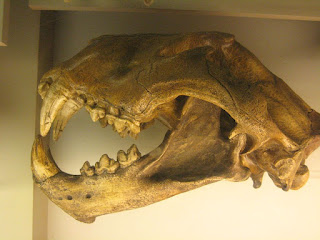
Cast of a skull of Pleistocene North American lion, Panthera atrox.
Cast of Panthera atrox skull. A skull like this could
have belonged to a lion in our Pleistocene Park.
By Claire H. from New York City, USA [CC BY-SA 2.0 ],
via WikimediaCommons. 

Panthera leo

Yes, there would be honest-to-goodness lions in our North American Pleistocene Park. Some scientists consider the American lion (P. atrox) its own species.

Panthera tigris

Tigers were also around in the Pleistocene, and they might have crossed the land bridge from Asia into North America, thus entering our park.

Genus Felis

Felis concolor

Some of you may recognize this as the scientific name of the mountain lion, otherwise known as the puma or cougar. These cats are known only in the Americas, and they appear in the fossil record from about 500,000 years ago.

Genus Miracinonyx

These cats were similar to modern cheetahs and may have been a primitive form of cheetah. The genus is known in North America from fossil remains of two species, M. inexpectatus and M. trumani. The older M. inexpectatus, from about 3.2 million years ago, is out of the time range of our park, but M. trumani was from 10,000–20,000 years ago, so they’d fit in nicely. Their bones were similar to those of modern cheetahs, but their claws were more fully retractable (modern cheetahs have semi-retractable claws).

Illustration showing relative sizes of three Smilodon species and a human.
In case you're wondering, here you can see the
relative sizes of the three Smilodon species.
That blue man should stop waving and start running!
By Matthew Martyniuk, adapted from 2001 original
by Walking with Beasts (Own work) [GFDL], via Wikimedia Commons. 

Genus Smilodon

And so we come to perhaps the most famous of the Pleistocene cats, the saber-toothed cats of genus Smilodon. These cats are known from North and South America, and the last of them became extinct about 10,000 years ago. In the famous La Brea Tar Pits of California, at least 12,000 individuals have been found.

Three species are recognized:

  1. S. gracilis was the smallest and earliest (2.5 million to 500,000 years ago) of the three. They lived in what is today the eastern United States.
  2. S. populator was the largest (the size of a modern lion). They are known from eastern South America, and they had huge upper canines.
  3. S. fatalis, the species that would be appropriate for our park, fell between the other two in size. They are known mostly from Pleistocene deposits in North America, though they have also been found in South America. When you think “La Brea Tar Pits” (or "Pleistocene Park"), think “Smilodon fatalis”!

Fossil skull of saber-toothed cat, Smilodon fatalis.
And what would a story about Pleistocene cats be
without a saber-toothed cat skull? This one is
Smilodon fatalis.
By James St. John [CC BY 2.0], via Wikimedia Commons.
We hope you've enjoyed this brief journey to meet the cats of Pleistocene Park. We really did not know there were so many species of big cats way back then, and they weren't all saber-toothed. Thanks to National Fossil Day, now we know!

Want more prehistoric cats? See Meet the Cat of All Cats: He's 25 Million Years Old and How Long Did It Take for a Saber-Toothed Cat to Grow Its Saber Teeth?

Source

Alan Turner, with illustrations by Mauricio Antón, The Big Cats and Their Fossil Relatives (New York: Columbia University Press, 1997).
If you are in to big prehistoric cats at all, I think you’ll find this book an excellent reference. The paperback is reasonably priced, it’s readable, and it’s heavily illustrated, including 16 color plates. Highly recommended!

The link below is an Amazon Associates link. If you purchase the book through this link, old SoLT and I could get some coin for our kibble account.


Wednesday, October 14, 2015

An American Lion, in Fossil Form

Wordless Wednesday


The skeleton of an extinct American lion (Panthera atrox) found
in the La Brea tar pits, Los Angeles, California. The American
lion was one of the largest cats that ever lived, and was larger
than the modern African lion. They roamed parts of North America
during the Pleistocene epoch  (340,000-11,000 years ago).
This specimen is in the George C. Page Museum in Los Angeles.
Photo by Ed Bierman.
[CC BY 2.0 (http://creativecommons.org/licenses/by/2.0)],
via Wikimedia Commons.
And this reconstruction shows what the American lion might have
looked  like in the flesh. By Sergiodlarosa.
  CC-BY-SA-3.0 (http://creativecommons.org/licenses/by-sa/3.0/),
via Wikimedia Commons.

Friday, July 3, 2015

How Long Did It Take for a Saber-Toothed Cat to Grow Its Saber Teeth?


We are reaching deep into feline history today, all the way back to the Pleistocene epoch (2.5 million to 11,500 years ago, give or take), to learn something about our long-lost cousin the saber-toothed cat (that’s Smilodon fatalis if you want to be scientific). Why? Well, because, thanks to a new study, we now know how long it took these animals to grow their huge canine teeth, and we think that's pretty interesting.


Here, kitty kitty—not!
Saber-toothed cat illustration on signage at the
Cincinnati Museum of Natural History & Science,
Cincinnati, Ohio.
Photo by James St. John
[CC BY 2.0], via Wikimedia Commons. 

A bit about the saber-toothed cat

Saber-toothed cats lived in North America and parts of South America until they went extinct 13,000 years ago. They probably weighed from 350 pounds to just over 600 pounds and stood nearly 40 inches tall at the shoulder. Oh, and those teeth we’re so interested in could be seven inches long and were serrated on both edges. (This is not a cat you’d want to have napping on your couch.)


Saber-tooth cat skull at the
Regional Museum of Guadalajara
in Guadalajara, Mexico.
Photo by Thelmadatter (Own work)
[Public domain], via Wikimedia Commons.

Growing those saber teeth

Perhaps not surprisingly, it took a while for those big canine teeth to fully erupt, or push through the gums. According to a brand-new study using fossils from Rancho La Brea in southern California, permanent canine teeth began to erupt when saber-tooth cubs were between one and one and a half years old. The teeth erupted at about six millimeters (just under a quarter of an inch) per month, faster than the rate for modern lions, and a little more than half as fast as human hair grows.

At that rate, the saber teeth weren't fully erupted and at full size until the cats were about three years old.

To give you a little perspective, modern domestic cats have all their adult teeth ready to go when they’re about six months old.

Baby canines and adult sabers side by side

The saber-tooth’s baby (or deciduous) canines finished erupting when the cat was about a year to a year and half old (the same time the adult sabers began to erupt). Then, as the permanent saber teeth erupted, the baby teeth remained in place for almost a year, possibly to keep the saber teeth from being broken.

Young saber-tooth cubs rare at Rancho La Brea

Using the tooth data to estimate ages of saber-toothed cats found at Rancho La Brea, the researchers found that cubs under four to seven months old were rarely preserved there. This makes sense when you consider that those younger cubs wouldn’t have had fully erupted baby canine teeth yet. Until they were well-equipped for defense, the cubs were probably kept closer to the den to keep them away from predators.

For more on prehistoric cats, see Meet the Cat of All Cats: He's 25 Million Years Old.

Sources

Wysocki MA, Feranec RS, Tseng ZJ, Bjornsson CS (2015) Using a Novel Absolute Ontogenetic Age Determination Technique to Calculate the Timing of Tooth Eruption in the Saber-Toothed Cat, Smilodon fatalis. PLoS ONE 10(7): e0129847.